
Insurance can feel like a foreign language. You read a policy and feel lost. The words are long and confusing. But you need to understand them. Your financial safety depends on it. We are here to help you today.
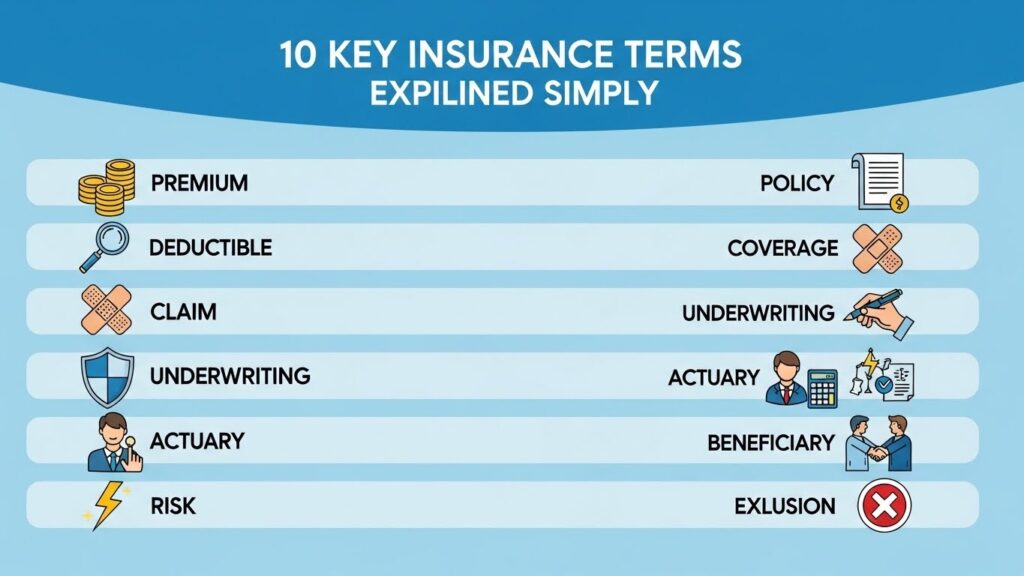
We have created this guide for you. It covers 10 Key Insurance Terms Explained Simply. You will finish this article feeling confident. You will know exactly what you are buying. Let’s dive into the world of insurance.
Why Understanding Insurance Jargon Matters
You might think jargon is boring. We understand that feeling completely. But these words cost you money.
If you don’t know them, you lose cash. You might buy the wrong plan. You might miss out on a claim. Knowledge is your best power here.
We want you to save money. We want you to be protected. You deserve peace of mind. Let’s look at the first term.
1. Premium
What Is a Premium?
This is the most common term. You will see it everywhere.
Think of it as a subscription fee. You pay Netflix a monthly fee. You pay your insurer a premium. It is the cost of your policy.
You must pay this to stay covered. If you stop, your coverage stops. It is that simple.
How Do You Pay It?
You can pay it in different ways. Some pay it every month. Others pay it once a year.
Paying yearly can sometimes save money. Insurers like getting money upfront. They might give you a discount. You should ask your agent about this.
What Changes Your Premium?
Your premium is not random. It is based on risk.
- Your Age: Younger drivers often pay more.
- Your Health: Smokers pay higher life insurance.
- Your Location: City dwellers might pay more.
- Your History: Accidents raise your car premium.
You have some control here. Drive safely to lower costs. Quit smoking to save on life insurance.
“Price is what you pay. Value is what you get.” – Warren Buffett
Always look for value, not just low premiums.
2. Deductible
The Definition
This term confuses many people. Let’s make it clear.
A deductible is what you pay first. You pay this before the insurer pays. It is your share of the risk.
How It Works in Real Life
Imagine you have a car accident. The repairs cost $5,000. Your policy has a $1,000 deductible.
You will pay the mechanic $1,000. Your insurance company pays the remaining $4,000.
You do not pay the deductible for everything. Usually, it applies to big claims. Routine checkups might be free. This depends on your specific plan.
The Premium vs. Deductible Balance
This is a crucial concept. You need to understand this balance. It works like a seesaw.
When one goes up, the other goes down. You have to choose your preference.
Table 1: The Cost Balance
| Scenario | Deductible Amount | Monthly Premium | Best For… |
|---|---|---|---|
| Option A | High ($2,000) | Low | People with savings. |
| Option B | Medium ($1,000) | Average | The standard choice. |
| Option C | Low ($250) | High | People who claim often. |
Note: Choose what fits your budget.
If you have emergency savings, choose Option A. You save money each month. If you have no savings, choose Option C. It is safer for your wallet later.
3. Policy Limit (Limit of Liability)
What Is a Limit?
Insurance does not pay forever. There is always a cap. This cap is the Policy Limit.
It is the maximum amount they pay. Once you hit the limit, you pay.
Types of Limits
You will see different types of limits.
- Per Occurrence: The max for one single accident.
- Aggregate: The max for the whole policy year.
Why Limits Matter
Imagine a bad house fire. Your house costs $300,000 to rebuild. But your policy limit is only $200,000.
You are short $100,000. You have to pay that yourself. That could ruin your finances.
We suggest reviewing your limits often. Inflation makes repairs more expensive. Your old limit might be too low now. Check this every year.
For more on how limits work across different states, you can check the National Association of Insurance Commissioners (NAIC). They have great consumer resources.
4. Claim
The Request for Money
A claim is a formal request. You are asking the company for money.
You suffered a loss. You have a policy. Now you want them to pay.
The Process
The process can feel stressful. But it follows a set path.
Chart: The Simple Claims Flow
- Event Happens (Accident/Theft/Illness)
↓ - You Notify Insurer (Call or App)
↓ - Proof Submission (Photos/Police Report)
↓ - Adjuster Reviews (They check the damage)
↓ - Decision Made (Approved or Denied)
↓ - Payment Sent (Money goes to you or repair shop)
Tips for Claims
You should act fast. Do not wait to file. Take pictures of everything. Keep all your receipts.
Honesty is the best policy here. Never lie on a claim. That is insurance fraud. It is a crime.
5. Exclusion
What Is Not Covered
No policy covers everything. There are always things left out. These are called exclusions.
You must read the fine print. This is where people get angry. They think they are covered. Then they find out they are not.
Common Examples
We have listed common exclusions below. This helps you know what to look for.
Table 2: Typical Exclusions by Policy Type
| Insurance Type | Common Exclusions | Why? |
|---|---|---|
| Auto | Wear and tear | Maintenance is your job. |
| Home | Floods / Earthquakes | These require separate policies. |
| Health | Cosmetic surgery | It is not medically necessary. |
| Life | Dangerous hobbies | High risk means high danger. |
How to Fix Gaps
You can sometimes buy back coverage.
If you live in a flood zone, buy flood insurance. Do not assume your home policy covers it. It usually does not.
You can visit the Insurance Information Institute to learn more about specific exclusions for natural disasters.
6. Rider (Endorsement)
Customizing Your Plan
Think of your policy as a pizza. The rider is the extra topping.
The standard policy is the cheese pizza. It is basic and good. But maybe you want pepperoni.
You add a rider to get it. It adds extra coverage. It also adds a small cost.
Why Use a Rider?
You have unique needs. A standard plan is generic.
Maybe you have expensive jewelry. A standard home policy has limits. It might only pay $1,000 for jewelry. Your ring is worth $5,000.
You add a “Jewelry Rider.” Now your ring is fully covered.
Grid: Popular Riders You Might Need
- Jewelry Floater: For rings and watches.
- Sewer Backup: Vital for homeowners.
- Rental Car: For when your car is in the shop.
- Accidental Death: Pays extra on life insurance.
You should ask your agent about these. They are usually very cheap. They offer great value.
7. Beneficiary
Who Gets the Money?
This term is mostly for life insurance. The beneficiary is the person you choose.
They get the money when you die. It is a heavy topic. But it is very important.
Choosing a Beneficiary
You can pick anyone.
- Your spouse.
- Your children.
- A charity.
- A trust.
Primary vs. Contingent
You should name two types.
- Primary: The first person in line.
- Contingent: The backup person.
If the primary person dies before you, the backup gets it. This ensures the money doesn’t get stuck.
Keep It Updated
You must update this list. Did you get divorced? Did you have a new baby?
Change your beneficiary immediately. If you don’t, your ex-spouse might get the money. You surely do not want that.
8. Grace Period
A Safety Net for Payments
Life gets busy. You might forget a bill.
The grace period saves you. It is extra time to pay.
Usually, it is 30 days. If your bill is due on the 1st, you have until the 30th.
What Happens During Grace Period?
Your coverage stays active. You are still safe.
If you have an accident on the 15th, they pay. Even if you haven’t paid the premium yet.
What Happens After?
If the grace period ends, watch out. Your policy will lapse.
This means you have no insurance. If you pay late now, they might say no. You might have to apply again. You might pay higher rates.
Do not rely on this often. Set up auto-pay. It prevents this stress.
9. Co-payment (Co-pay)
Small Fee, Big Service
This is a health insurance term. You see this at the doctor.
A co-pay is a flat fee. You pay it on the spot.
How It Works
You go to the doctor. The visit costs $150. Your insurance card says “Co-pay: $20”.
You pay the receptionist $20. You are done. The insurance pays the rest.
Co-pay vs. Deductible
This confuses people.
- Deductible: You pay big amounts for big bills.
- Co-pay: You pay small amounts for visits.
Usually, co-pays do not count toward your deductible. They are separate costs.
Grid Features: Where You Pay Co-pays
- Primary Care Doctor
- Specialists (Cardiologist, Dermatologist)
- Urgent Care Centers
- Prescription Drugs
Note: Emergency Rooms usually have much higher co-pays.
10. Underwriting
The Behind-the-Scenes Process
You submit an application. Then you wait.
During this wait, underwriting happens. This is the risk assessment.
What Do Underwriters Do?
They are like detectives. They look at your data.
- Medical records.
- Driving history.
- Credit score.
- Lifestyle choices.
They decide two things.
- Will they insure you?
- How much will you pay?
The Result
If you are low risk, you get a low price. If you are high risk, you pay more. Sometimes, they deny you.
You cannot lie to them. They have databases. They will find out. Always tell the truth on applications.
Bonus: How These Terms Work Together
We have learned the parts. Now let’s see the whole engine.
Imagine you buy a policy.
- You submit an app (Underwriting).
- You pay a monthly fee (Premium).
- You crash your car. You file a request (Claim).
- You pay your share first (Deductible).
- The insurer pays the rest, up to the max (Policy Limit).
It is a cycle. Each term connects to the other.
“Insurance is the only product you buy that you hope to never use.”
This is very true. But when you need it, you are glad it is there.
Tips for Lowering Your Costs
We want to save you money. Here are quick tips.
- Bundle Policies: Buy home and auto together.
- Raise Deductibles: If you have savings, raise the deductible.
- Improve Credit: Good credit often means lower rates.
- Ask for Discounts: Ask about “safe driver” or “good student” discounts.
You have the power to negotiate. Do not be afraid to ask.
Conclusion
We have covered a lot today. We looked at 10 Key Insurance Terms Explained Simply.
You now know what a premium is. You understand deductibles. You know how claims work.
Insurance is no longer a mystery. It is a tool. You use it to protect your life. You use it to protect your wealth.
Review your policies today. Look for these words. Do you have enough coverage? Are you paying too much?
You are smarter now. You can make better choices. We hope this guide helps you feel secure.
If you have questions, read your policy. Or call your agent. They are there to help you.
Stay safe. Stay insured.
Frequently Asked Questions (FAQs)
1. Can I get insurance without a deposit?
Usually, no. Most insurers require the first month’s premium upfront to start the policy.
2. Does my credit score affect my premium?
Yes. In most states, a higher credit score can lower your insurance costs significantly.
3. What is the difference between a quote and a policy?
A quote is an estimate of price. A policy is the actual legal contract and final price.
4. Can I change my deductible later?
Yes. You can usually call your agent and change your deductible at any time.
5. Is life insurance taxable for beneficiaries?
Generally, no. Life insurance payouts are usually tax-free for the people receiving them.