
You just bought a car. It is an exciting moment. The smell of the new interior is great. But then comes the paperwork. You have to deal with insurance now. It can feel very confusing. You see many terms thrown around. Two terms come up the most.
Liability vs. full coverage: what’s the difference? This is the big question.
Understanding this is vital for you. It protects your car. It also protects your bank account. You do not want to make a mistake. A wrong choice can cost thousands. We are here to help you.
In this guide, we will break it all down. We will speak simply. No complex jargon. Just facts you can use today. Let’s dive into the details together.
The Basic Definitions
First, we need to define the terms. You cannot choose without knowing the basics.
What is Liability Insurance?
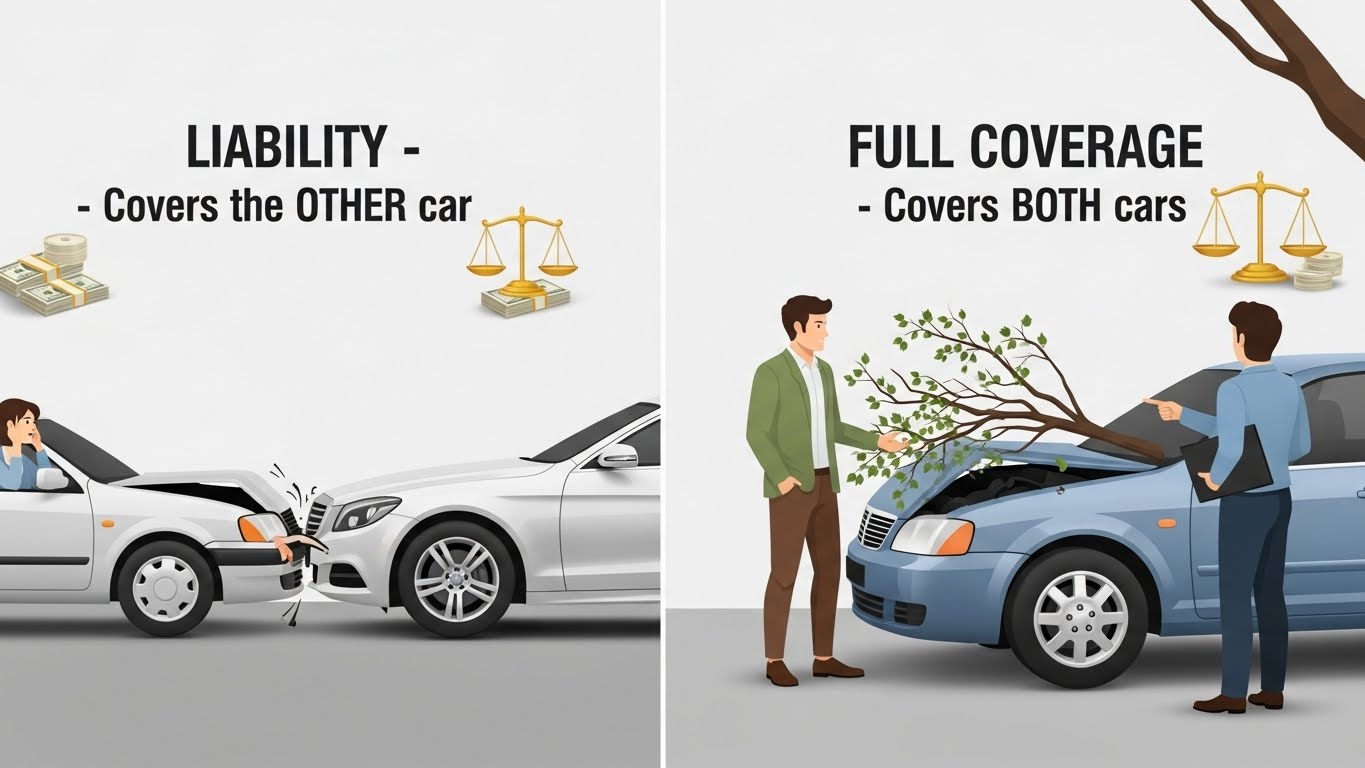
Liability is the foundation. It is usually required by law. Almost every state demands it. Think of it as your responsibility coverage.
It does not cover you. It covers the other person. If you cause a crash, it pays. It pays for their car repairs. It pays for their medical bills.
It protects you from lawsuits. If you hurt someone, they might sue. Liability insurance steps in to help. It shields your personal assets.
What is Full Coverage?
“Full coverage” is actually a nickname. It is not a specific policy name. You won’t see “Full Coverage” on a legal document.
It is a bundle of coverages. It combines Liability with other protections. It usually includes Collision and Comprehensive.
It protects your own car. Even if the accident is your fault. It also covers theft and weather damage. It is complete protection for your vehicle.
The Core Components of Liability
Let’s look deeper at liability. It splits into two main parts. You need to understand both.
1. Bodily Injury Liability (BI)
This is about people. Accidents can hurt people. Medical bills are very expensive.
If you are at fault, you pay. BI covers the other driver’s injuries. It covers their passengers too. It can also cover pedestrians.
It usually has limits. There is a limit per person. There is a limit per accident. You choose these limits when buying.
2. Property Damage Liability (PD)
This is about things. It covers physical damage.
You might hit another car. You might hit a fence. You could hit a storefront. PD pays to fix these things.
It does not fix your car. It only fixes what you destroyed. This is a crucial distinction.
“Liability insurance is for them. Full coverage is for you. Remember this simple rule.”
The Core Components of Full Coverage
Full coverage adds more layers. It fills in the gaps. It usually adds two major things.
1. Collision Coverage
This is for driving accidents. It covers your vehicle repairs.
Imagine you hit another car. Or perhaps you hit a tree. Maybe you back into a pole. Collision coverage pays for this damage.
It works even if you are at fault. It usually has a deductible. You pay the deductible first. Then the insurance pays the rest.
2. Comprehensive Coverage
This covers non-driving events. Sometimes bad luck happens.
Imagine a storm hits. Hail dents your hood. Or a tree branch falls. Maybe a deer runs out. Or sadly, someone steals your car.
Comprehensive covers all of this. It protects against nature and theft. It also handles fire and vandalism.
Comparison Table: Liability vs. Full Coverage
Let’s look at this visually. This table shows who gets paid.
| Feature | Liability Only | “Full Coverage” |
|---|---|---|
| Covers Other Driver’s Injury | Yes | Yes |
| Covers Other Driver’s Car | Yes | Yes |
| Covers YOUR Car (Accident) | No | Yes |
| Covers Theft of Your Car | No | Yes |
| Covers Weather Damage | No | Yes |
| Covers Vandalism | No | Yes |
| Required by State Law | Yes | No (Optional) |
| Required by Car Loan | No | Yes |
Why Is Liability Mandatory?
You might wonder why it is law. Why does the state care?
It is about public safety. Cars are dangerous machines. Accidents cause massive financial loss. Most people cannot pay out of pocket.
If you ruin a $50,000 car, can you pay? Most of us cannot. Liability ensures victims get paid. It keeps the economy moving.
Driving is a privilege. It is not a right. To drive, you must be responsible. Liability insurance proves financial responsibility.
The Cost Factor: What to Expect
Price is always a huge factor. We all want to save money.
Liability is the cheapest option. It covers less, so it costs less. It is the budget-friendly choice.
Full coverage costs significantly more. It might be double the price. Sometimes it is even triple.
Why is it so expensive? Because the insurer takes more risk. They might have to replace your whole car. That is expensive for them.
Grid: Factors That Raise Your Rates
Here are things that impact your price. Insurers look at these closely.
:: The Pricing Grid ::
- Your Age: Young drivers pay more.
- Your Location: Cities are more expensive.
- Driving Record: Tickets raise your rates.
- Car Type: Sports cars cost more.
- Credit Score: Bad credit can hurt you.
- Deductible: Lower deductible means higher premium.
When Should You Choose Liability Only?
You do not always need full coverage. Sometimes it is a waste of money. When is liability enough?
1. You Have an Old Car
Think about your car’s value. Is it an old clunker? Is it worth less than $3,000?
If you wreck it, the payout is small. You might pay more in premiums. Over a few years, you lose money.
2. The 10% Rule
We use a simple math rule. Look at your annual premium. Is it 10% of the car’s value?
If the insurance costs $1,000 a year. And the car is worth $2,000. That is 50%. That is a bad deal. You should drop full coverage.
3. You Own the Car Outright
Do you have a loan? If yes, you cannot drop coverage. The bank owns the car.
If you have the title, you choose. You are the boss. You can take the risk.
4. You Have an Emergency Fund
Imagine you crash tomorrow. Can you buy a new car? Do you have cash in the bank?
If yes, you can self-insure. You take the risk yourself. You save on monthly premiums.
When Must You Have Full Coverage?
Sometimes you have no choice. Other times it is just smart.
1. You Are Financing or Leasing
Banks protect their assets. The car is their collateral. If you crash, they want their money.
They will force you to have it. It is in the loan contract. If you cancel, they will know. They might add “force-placed” insurance. That is very expensive.
2. You Have a New Car
New cars are expensive. Replacing one costs a lot.
A minor fender bender can cost thousands. Modern cars have sensors. Bumpers are full of technology. Repairs are not cheap anymore. Full coverage is vital here.
3. You Cannot Afford Repairs
Look at your bank account. Do you have $5,000 for repairs?
If not, you need insurance. It acts as a safety net. You pay a small deductible. The insurance company pays the big bill. It keeps you on the road.
Understanding Deductibles
We mentioned deductibles earlier. Let’s explain them fully. This confuses many people.
A deductible is your share. It is what you pay first.
Example Scenario:
You have a $500 deductible. You hit a pole. The damage is $2,000.
- You pay the shop $500.
- The insurance pays the shop $1,500.
Choosing Your Deductible:
- High Deductible ($1,000+): Lowers your monthly bill. But you pay more in a crash.
- Low Deductible ($250): Raises your monthly bill. But you pay less in a crash.
Choose what fits your savings. Keep that money ready.
Key Features Chart: Protection Levels
Here is how the protection stacks up. See the layers of safety.
Level 1: Basic (Liability)
- Other People’s Injury
- Other People’s Property
Level 2: Plus (Add-ons)
- Uninsured Motorist Coverage
- Medical Payments (MedPay)
Level 3: Full (Comprehensive/Collision)
- Your Car’s Body Work
- Your Car’s Total Loss
- Theft and Fire
- Glass Repair
The Myth of “Full Coverage”
We need to bust a myth. “Full coverage” does not mean everything.
It does not cover everything imaginable. There are exclusions. You need to know them.
What Is Usually Left Out?
- Wear and Tear: Tires wearing out is on you.
- Mechanical Failure: If the engine blows, insurance won’t pay. Unless it was from a crash.
- Racing: If you race, you are not covered.
- Intentional Damage: You cannot crash on purpose.
You might need extra add-ons. Like Gap Insurance. Or Rental Car Reimbursement. These are extras. They are not automatic.
Gap Insurance Explained
This is crucial for new cars. As soon as you drive off, value drops. This is depreciation.
You might owe $30,000. But the car is worth $25,000. You crash and total it.
Insurance pays the value ($25,000). You still owe the bank ($5,000).
Gap insurance pays that $5,000. It saves you from debt.
If you have a loan, consider this. It is very helpful.
Uninsured Motorist Coverage
This is another vital piece. What if the other driver has no insurance?
It happens often. They hit you. It is their fault. But they have no money.
Liability covers them. But they don’t have it. Your Uninsured Motorist coverage steps in. It pays your medical bills. It acts like their liability.
Is this part of full coverage? Usually, yes. But check your policy. In some states, you must reject it in writing.
How to Decide: A Step-by-Step Guide
You are still unsure. Let’s make a plan. Follow these steps.
- Check Your Loan Status: Do you owe money? If yes -> Full Coverage.
- Check Your Car Value: Look up Blue Book value. Is it low?
- Check Your Budget: Can you afford a new car cash?
- Compare Quotes: Get prices for both. See the difference.
If the difference is small, keep full coverage. Peace of mind is worth it.
“Insurance is not just a cost. It is a shield for your lifestyle. Choose wisely.”
External Resources
You should research further. Here are trusted sites. They offer neutral advice.
- You can check the Insurance Information Institute (iii.org). They have great data on safety.
- Also, visit NHTSA (nhtsa.gov). They cover vehicle safety ratings.
Use these to check your car’s safety. Safe cars are cheaper to insure.
The Claims Process Differences
How does a claim work? It depends on your coverage.
With Liability Only:
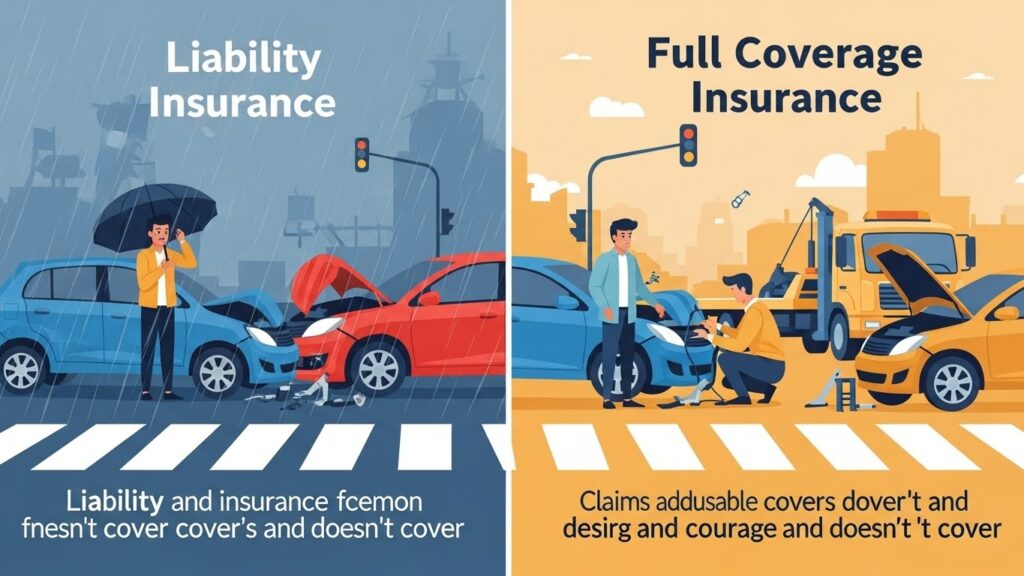
You crash. It is your fault. You call insurance. They talk to the other driver. They pay them. You are left alone. You must tow your own car. You must find your own repair shop. You pay every cent for your car.
With Full Coverage:
You crash. You call insurance. They send a tow truck. They recommend a shop. An adjuster looks at your car. They cut a check for repairs. You just pay the deductible. It is much less stress.
Regional Differences
Where you live matters. States have different laws.
Some states are No-Fault. In these states, you use your own insurance first. This applies to injuries.
In Tort states (At-fault), the person who caused it pays.
Full coverage is smart in cities. Cities have high theft rates. They have more traffic. The risk is higher.
Rural areas have different risks. Deer strikes are common. Comprehensive coverage helps there.
Shopping for the Best Rates
You want full coverage. But you want a liability price. Is it possible?
You can get close. You have to shop around. Do not take the first offer.
Tips for Lower Rates:
- Bundle Policies: Combine home and auto.
- Drive Safely: Use a tracking app.
- Ask for Discounts: Good student? Military? Ask them.
- Improve Credit: Pay bills on time.
We recommend checking rates yearly. Loyalty does not always pay. New customers often get better deals.
The Mental Peace Aspect
Money is not everything. Stress is real.
Driving without full coverage is scary. Every noise makes you jump. Every storm makes you worry.
Full coverage buys sleep. You know you are safe. If a tree falls, you are okay. If you slide on ice, you are covered.
This mental freedom has value. Do not ignore it.
Common Mistakes to Avoid
We see people make errors. Do not be like them.
- Under-insuring: Minimum liability is risky. If you cause a big crash, it runs out. You get sued for the rest. Buy more than the minimum.
- Dropping Coverage Too Soon: Don’t drop it just to save $20. Make sure the math works.
- Ignoring Exclusions: Read the fine print. Know what is not covered.
- Lying on Applications: Be honest about miles. Be honest about drivers. They will find out. They will deny claims.
Analyzing the “Total Loss” Scenario
What is a total loss? It means the car is “totaled.”
This happens when repairs cost too much. Usually 75% of the value.
Liability Only:
Your car is totaled. You get $0. You have no car. You walk or take the bus.
Full Coverage:
Your car is totaled. They pay the current market value. You get a check. You can go buy another car.
This is the biggest difference. It changes your life after an accident.
How to Switch Coverages
You can change anytime. You are not stuck.
Did your car get old? Call your agent. Tell them to remove collision. Keep comprehensive maybe. It is cheaper.
Did you buy a new car? Call immediately. Add full coverage before you drive.
Do not let coverage lapse. A gap in coverage raises rates. It looks bad to insurers.
Medical Payments (MedPay) and PIP
Let’s touch on medical coverage. This is often part of the “full” package.
Liability pays their doctors. Who pays yours?
MedPay helps you. It pays your medical bills. It works quickly.
PIP (Personal Injury Protection) is stronger. It covers lost wages too. If you cannot work, PIP helps.
These are vital if you lack health insurance. They are good supplements even if you have it.
Final Thoughts on Liability vs. Full Coverage: What’s the Difference?
We have covered a lot. Let’s summarize.
Liability is the legal minimum. It protects your assets from lawsuits. It does not fix your car. It is for the budget-conscious with older cars.
Full Coverage is the total package. It protects your vehicle. It handles theft, weather, and accidents. It is for new cars and peace of mind.
You must evaluate your life. Look at your finances. Look at your car.
Make the choice that lets you sleep at night. Do not gamble with your financial future. Insurance is a tool. Use it well.
We hope this guide helped you. You are now ready to decide. Drive safe out there.
Frequently Asked Questions (FAQs)
Here are answers to your quick questions.
1. Is full coverage required by law?
No, states only require liability. However, lenders require full coverage if you have a loan.
2. Can I have full coverage on an old car?
Yes, you can. But it might cost more than the car is worth. Do the math first.
3. Does liability cover theft?
No, it does not. You need comprehensive coverage to protect against theft or vandalism.
4. What is the cheapest insurance option?
Liability-only is the cheapest. It offers the least protection. It carries the highest financial risk for you.
5. Can I switch from full coverage to liability?
Yes, anytime. As long as you do not have an active car loan, you can switch.