
You are driving down the road. The music is playing softly. You feel calm and relaxed. Suddenly, tires screech loudly nearby. Then, you feel a massive jolt. Glass shatters everywhere around you.
The silence that follows is heavy. You have just had a crash. Your heart beats very fast. Your hands might start shaking. It is hard to think clearly. Panic sets in very quickly.
This is a normal reaction. But you need to focus. You need a plan immediately. This Car Accident Checklist is that plan. It guides you through the chaos.
We have written this for you. It covers exactly what to do. Follow these steps to stay safe. They will protect your legal rights. They also help your insurance claim.
Let’s get you through this safely.
Why You Need This Checklist
Memory fails us during high stress. You might forget crucial details. Adrenaline makes everything feel blurry. You might say the wrong thing.
A checklist keeps you grounded. It tells you where to look. It reminds you who to call. It stops you from making mistakes.
Insurance companies are strictly business. They look for small errors. One mistake can cost you money. This guide prevents those costly errors.
We want you to be prepared. Keep this guide in your phone. Or print it for your glovebox. You will be glad you did.
“Safety is not an accident. It is a choice we make.”
Step 1: Stop and Ensure Safety
This is the most critical step. Never drive away from a scene. That is considered a crime. It is called a hit-and-run.
Stop the Car Immediately
You must stop your vehicle now. Do not block traffic if possible. Move to the shoulder safely. If the car is wrecked, leave it.
Turn off the engine immediately. This prevents potential fire hazards. Turn on your hazard lights. This warns other drivers approaching.
Check for Major Injuries
Take a deep breath right now. Check yourself for any pain. Look at your passengers too. Ask them if they are okay.
Do not move an injured person. You could make injuries worse. Only move them if necessary. For example, if there is fire.
Set Up Warning Signals
If you have emergency flares, use them. Put out safety triangles too. This helps prevent secondary accidents.
Stay out of the road. Stand far away from traffic. Do not stand between two cars. That is a dangerous spot.
Step 2: Call for Help Immediately
You need professional help now. Do not try to handle this alone.
Dial 911
Call the police or 911 immediately. Tell the operator your location. Tell them if people are hurt. Be clear and calm.
Even for minor bumps, call them. You need an official record. This record is the police report. It is vital for insurance.
Do Not Let the Other Driver Talk You Out of It
The other driver might beg you. They might say, “Let’s settle cash.” Do not agree to this.
You do not know the damage. You do not know your injuries. Hidden costs can appear later. Always get the police involved.
Wait for the Officers
Stay at the scene until they arrive. Do not leave for any reason. When they arrive, be polite.
Give them your license and registration. Answer their questions honestly. Stick only to the facts. Do not guess about what happened.
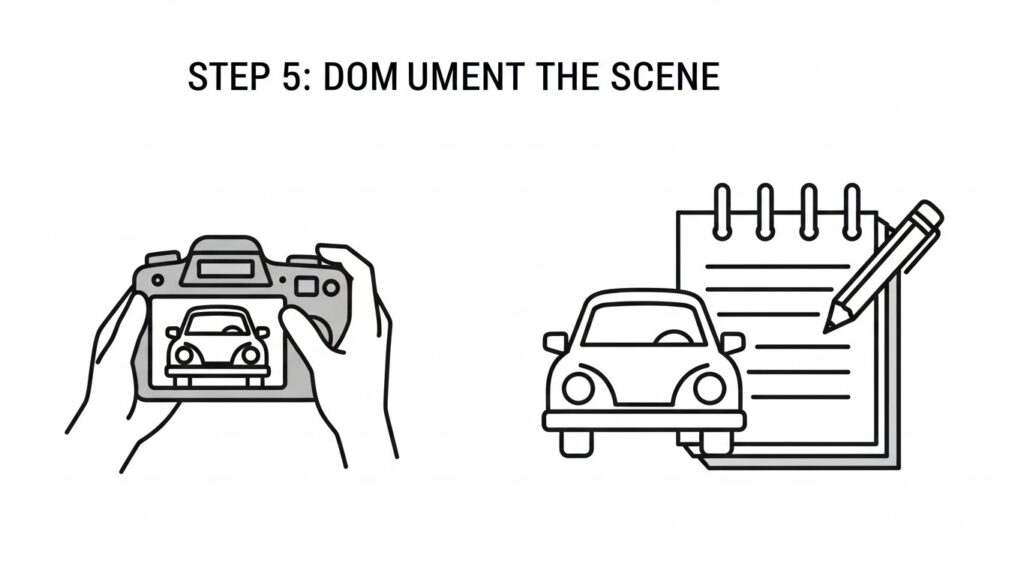
Step 3: Document the Scene Thoroughly
Evidence disappears very quickly. You must capture it now. Your phone is your best tool.
Take Many Photos
Take pictures of all the vehicles. Photograph the damage close up. Photograph the damage from far away.
Take pictures of the entire scene. Show the skid marks on road. Show the broken glass debris. Show the traffic signs nearby.
Take photos of the weather too. Was it raining or sunny? Was the road wet or dry? This context helps your case.
Video Walkthrough
Walk around the cars while recording. Narrate what you are seeing. Point out the specific damages.
Record the position of cars. Show where they stopped resting. This shows how the impact happened.
Scan for Witnesses
Did anyone see the crash happen? Look for pedestrians on sidewalks. Look for other stopped drivers.
Ask for their names politely. Ask for their phone numbers. Witness testimony is very powerful. It can prove you are right.
Step 4: Exchange Information Wisely
You must trade info with others. But be careful what you say.
What to Share
We have made a table for you. This shows what you must get. It keeps things organized for you.
Table 1: The Essential Data Exchange
| Information Type | Details You Need | Why You Need It |
|---|---|---|
| Driver Details | Name, Phone, Address | To identify who hit you. |
| Vehicle Info | Make, Model, Plate # | To link the car to the driver. |
| Insurance Data | Company Name, Policy # | To file your claim properly. |
| Location Info | Street Name, City, Time | For the official accident report. |
What NOT to Share
Do not give your social security number. Do not show your driver’s license photos. Just let them write the info.
Do not discuss whose fault it is. Do not apologize to the driver. Do not say “I didn’t see you.”
These words can be used against you. They imply that you are guilty. Just exchange the data and wait.
Step 5: Watch Your Words
This is harder than it sounds. We are naturally polite people. We want to say “I’m sorry.”
The “Sorry” Trap
In an accident, “sorry” implies guilt. It is an admission of fault. Insurance adjusters look for this.
Even if you think you messed up, wait. You might not know the whole story. The other driver might be speeding. Their brake lights might be broken.
Talking to Police
Tell the officer what you saw. “I was driving north.” “He hit my side.”
Do not guess speeds. Do not guess distances. If you don’t know, say so. “I am not sure” is okay.
Talking to the Other Driver
Keep conversation very brief. Ask if they are okay. Exchange the required information. Then go wait in your car.
Do not get into an argument. Do not get angry or yell. Road rage makes things worse. Stay calm and stay safe.
Step 6: Seek Medical Attention
You might feel fine right now. You might think, “I am tough.” But your body is tricking you.
The Adrenaline Mask
Adrenaline is a powerful hormone. It blocks pain receptors temporarily. It is a survival mechanism.
You could have whiplash. You could have internal bleeding. You could have a concussion. You won’t feel it until later.
Go to the Doctor
Go to Urgent Care or ER. Go immediately after leaving the scene. Let a doctor examine you properly.
Tell them you were in a crash. They know what to look for. They will document your injuries.
Why This Matters for Insurance
If you wait three days, trouble starts. The insurance company will argue. They will say, “You weren’t hurt.”
They will claim the injury happened later. They will deny your medical bills. Going immediately links the injury to the crash.
Read More: For more on road safety, check the National Highway Traffic Safety Administration (NHTSA). They provide excellent safety data.
Step 7: Notify Your Insurance
Now the paperwork journey begins. You must call your agent. Do this as soon as possible.
Start the Claim
Call your insurance company provider. Tell them an accident occurred. Give them the basic facts.
Give them the other driver’s info. Give them the police report number. Upload the photos you took.
dealing with Adjusters
An adjuster will call you soon. They work for the insurance company. Their goal is to save money.
They might record your phone call. Be very careful with your answers. Stick to the facts only.
If the other driver’s insurance calls, pause. You do not have to speak. You can tell them to talk to your insurer. This protects you from tricks.
The Hidden Grid: Phases of an Accident
To help you visualize the timeline, we have broken it down. This grid shows the emotional and logical flow.
Grid 1: The Accident Timeline
| Phase | Your Feeling | Your Action | Priority |
|---|---|---|---|
| Impact | Shock, Panic | STOP the car. | Safety |
| Post-Crash | Confusion | Call 911. | Legal |
| On Scene | Anxiety | Take Photos. | Evidence |
| Next Day | Soreness | See Doctor. | Health |
| Next Week | Frustration | Handle Claim. | Finance |
Common Mistakes to Avoid
We see people make errors often. These errors cost them thousands. Let’s make sure you avoid them.
trusting the Other Driver
They might seem nice. They might promise to pay. But people change their minds.
Once they get home, they worry. They realize repairs are expensive. Then they stop answering your calls. Always go through insurance.
Posting on Social Media
Do not post about the crash. Do not put photos on Facebook. Do not tweet about your injuries.
Insurance investigators watch social media. If you post a smiling photo, watch out. They will say you aren’t hurt. Even a gym selfie can hurt your case. Stay offline for a while.
Signing Early Settlements
The insurance company might offer cash fast. They might send a check quickly. Do not cash it yet.
This is often a “lowball” offer. It might not cover future medical bills. Once you sign, it is over. You cannot ask for more later. Wait until you are fully healed.
When to Call a Lawyer
You do not always need a lawyer. But sometimes, they are necessary.
Serious Injuries
If bones are broken, get a lawyer. If you need surgery, get help. If you miss work, call one.
High medical bills are hard to recover. Lawyers know how to fight this. They negotiate better than you can.
Disputed Liability
If the other driver lies, you need help. If they say it was your fault, fight back. A lawyer gathers the evidence.
They can get camera footage. They can talk to witnesses. They protect your driving record.
The “No Win, No Fee” Structure
Most car accident lawyers work on contingency. This means you pay nothing upfront. They only get paid if you win.
This makes legal help accessible. It removes the risk for you.
Resource: The Insurance Information Institute (III) has great guides on how claims work. It is a trusted source.
Understanding Your Coverage
Insurance is confusing for most people. Let’s break down the terms.
Liability Insurance:
This pays for the other person. It fixes their car. It pays their medical bills. It is required by law.
Collision Coverage:
This fixes your own car. Even if the crash was your fault. It usually has a deductible.
Comprehensive Coverage:
This covers things other than crashes. Like theft or hail damage. It also covers hitting a deer.
Uninsured Motorist (UM):
This is very important coverage. What if the other driver has no insurance? UM coverage pays your bills then.
Handling the Aftermath
The crash is over, but stress remains. You might feel anxious driving.
Dealing with Anxiety
It is normal to feel scared. You might jump at loud noises. You might fear getting in a car.
Take it slow. Drive short distances first. If it persists, talk to a therapist. PTSD from crashes is real.
Getting Your Car Fixed
You have the right to choose. You pick the repair shop. The insurance cannot force you.
Choose a certified shop. Check their online reviews. Make sure they use original parts.
The Rental Car
If your policy covers it, get a rental. If not, the other driver’s insurance should pay. This takes time to set up.
Be prepared to pay a deposit. Keep the receipts for everything.
Accident Statistics: Why Awareness Matters
We want to show you reality. Accidents happen every single minute.
Chart Feature: Road Reality
(Imagine a bar chart here showing rising trends)
- Distracted Driving: This is the #1 cause today. Phones are the problem.
- Speeding: This causes the most severe crashes. Speed kills.
- Drunk Driving: This is entirely preventable. Yet it still happens.
Understanding these causes helps you. You can drive more defensively. You can spot the dangers early.
7 Steps Summary
Let’s recap the Car Accident Checklist briefly.
- Stop: Never drive away.
- Safety: Check for injuries.
- Call: Dial 911 immediately.
- Photos: Document the scene.
- Info: Exchange details safely.
- Doctor: Get checked medically.
- Insure: File your claim.
If you follow these, you win. You stay safe and protected.
Final Thoughts
We hope you never use this. We hope you drive safely always. But life is unpredictable.
Being prepared brings peace of mind. You know what to do now. You have the tools you need.
Share this guide with your family. Send it to your new teen driver. It could save them huge trouble.
Check your insurance policy today. Make sure you have enough coverage. Add Uninsured Motorist coverage if missing.
Drive safe. Stay alert. And keep this checklist handy.
Frequently Asked Questions (FAQs)
Here are the most common questions.
1. Should I call police for minor scratches?
Yes. You always need an official police report for insurance claims.
2. Can I move my car after a crash?
Yes, if it blocks traffic. Move it to the shoulder safely.
3. How long do I have to file a claim?
It varies by state. Usually, you should file within 24 hours.
4. What if the other driver has no insurance?
Call the police. Then contact your insurer about Uninsured Motorist coverage.
5. Should I accept the first settlement offer?
No. It is usually too low. Wait until your medical treatment finishes.