

Starting a business is a thrilling adventure. You have a vision. You have a plan. But you also face risks. This small business insurance starter guide is here to help. We will make insurance simple for you. You don’t need to be an expert. You just need the right information. Let’s protect your hard work together.
Why You Cannot Ignore Insurance
You might think insurance is too expensive. Or maybe you think risks are low. This is a common mistake. One lawsuit can ruin a small company. Accidents happen when we least expect them.
You have invested time and money. Do not leave your assets exposed. Insurance acts as a safety net. It catches you when things go wrong. It gives you peace of mind. You can focus on growth, not fear.
Also, some clients require it. They want to know you are safe. It builds trust with your partners. It shows you are a professional.
“Insurance is not just a cost; it is an investment in your business’s survival.”
Understanding the Basic Terms
Insurance language can sound confusing. Let’s break it down simply.
The Premium
This is the price you pay. You pay it monthly or yearly. It keeps your policy active.
The Deductible
This is what you pay first. You pay this before the insurer pays. A higher deductible lowers your premium.
The Limit
This is the maximum amount paid. The insurer won’t pay more than this. Choose limits that match your assets.
Core Policy: General Liability Insurance
This is the foundation of coverage. Most businesses need this first. It covers basic accidents.
Imagine a customer visits your shop. They trip over a rug. They break an ankle. They sue you for medical bills. General Liability (GL) pays for this.
It also covers property damage. If you break a client’s item, it pays. It covers advertising injuries too. This includes things like slander.
You cannot afford to skip this. It is essential for survival.
The Business Owner’s Policy (BOP)
This is a bundle deal. It saves you money. It combines two major coverages.
It includes General Liability. It also includes Commercial Property insurance. Insurers offer this to small businesses. It is cheaper than buying them separately.
Does your business have a location? Do you have equipment or inventory? Then a BOP is a smart choice. It is efficient and comprehensive.
Quick Comparison: GL vs. BOP
| Feature | General Liability (GL) | Business Owner’s Policy (BOP) |
|---|---|---|
| Primary Focus | Third-party injuries & damage | GL + Property Protection |
| Best For | Service businesses, freelancers | Retail, offices, shops |
| Cost | Generally lower | Moderate (Bundled savings) |
| Covers Building? | No | Yes |
| Covers Inventory? | No | Yes |
Commercial Property Insurance
Your physical assets matter. Think about your building. Think about your computers and tools.
Fire can destroy everything. Theft is also a major risk. A storm could damage your roof. Commercial Property insurance helps you rebuild.
It pays to repair or replace items. It covers furniture and inventory. Even if you rent, you need it. Your landlord’s policy won’t cover your stuff.
You must list your assets carefully. Don’t undervalue your equipment.
Professional Liability Insurance
Do you give advice? Do you provide a professional service? Then you need this coverage.
It is also called Errors and Omissions (E&O). It protects you from mistakes. Even a small error can cause loss.
If a client loses money because of you, they sue. They might claim you were negligent. They might say you missed a deadline.
Consultants need this. Accountants and lawyers need this. Real estate agents need this too. It pays for your legal defense. It pays for settlements.
Workers’ Compensation Insurance
Do you have employees? If yes, listen closely. This is usually required by law.
It covers workplace injuries. If a worker gets hurt, it pays. It pays their medical bills. It pays for lost wages.
It also protects you from lawsuits. If they take the money, they usually can’t sue. It is a trade-off.
Requirements vary by state. Check your local laws today. Don’t risk a fine. The penalties for skipping this are huge.
Check state requirements at the U.S. Small Business Administration (SBA)
Cyber Liability Insurance
We live in a digital world. Hackers are everywhere. Small businesses are big targets.
You store customer data. You have credit card numbers. You have email addresses. If you get hacked, it is bad.
Cyber insurance helps you recover. It pays for notifying customers. It pays for credit monitoring. It can pay for legal fees.
Do not think you are too small. Hackers use automated tools. They attack everyone. This coverage is becoming essential.
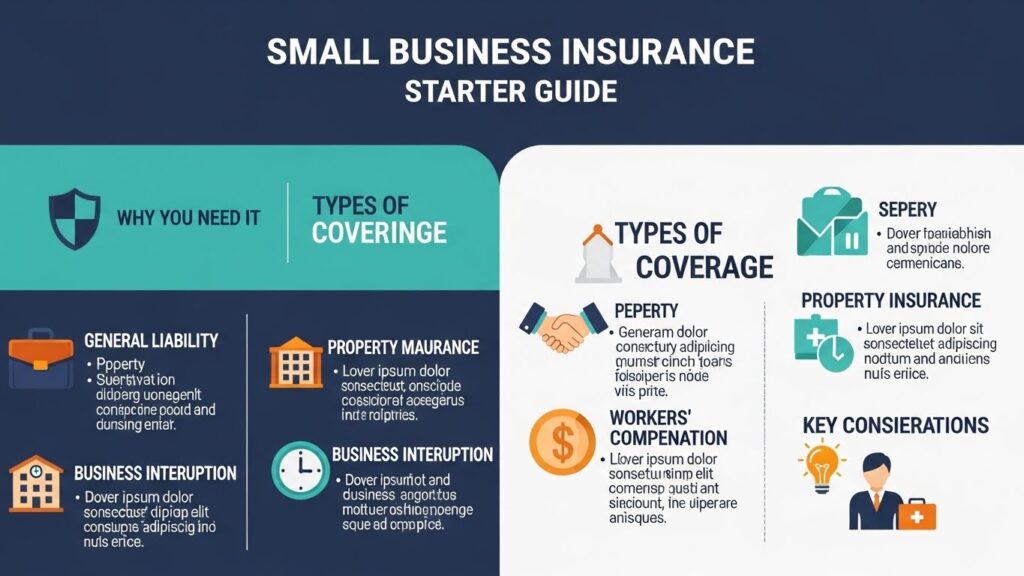
Commercial Auto Insurance
Do you use a car for work? Do you deliver goods? Personal insurance is not enough.
Personal policies exclude business use. If you crash while working, they deny the claim. You would have to pay everything.
Commercial auto covers your work vehicles. It has higher liability limits. It covers your employees driving your cars.
It protects your business assets. One bad accident can be expensive. Get the right policy for the road.
Business Income Insurance
Disasters stop your operations. A fire closes your shop. You cannot make money. But bills keep coming.
This insurance replaces lost income. It helps pay rent and payroll. It keeps you afloat while you repair.
It is often part of a BOP. It is a lifeline during disasters. It buys you time to recover. It prevents bankruptcy after a catastrophe.
Coverage Feature Grid
| Coverage Type | Bodily Injury | Property Damage | Legal Defense | Lost Income |
|---|---|---|---|---|
| General Liability | ✅ Yes | ✅ Yes | ✅ Yes | ❌ No |
| Professional Liab. | ❌ No | ❌ No | ✅ Yes | ❌ No |
| Commercial Prop. | ❌ No | ✅ Yes (Yours) | ❌ No | ❌ No |
| Business Income | ❌ No | ❌ No | ❌ No | ✅ Yes |
Specific Industry Needs
Every business is different. Your risks are unique. Let’s look at some sectors.
For Retail Stores
You have high foot traffic. People come in and out. Slip and fall risk is high. Theft is also a worry. You need a robust BOP. You need strong inventory coverage.
For Contractors
You work on other people’s property. You use dangerous tools. The risk of damage is high. You need General Liability. You also need “Inland Marine” for tools.
For Restaurants
You deal with food and heat. Fire is a major risk. Food poisoning is also a risk. Spoilage coverage is important. Liquor liability is needed if you serve alcohol.
For Tech Companies
You deal with data. You build software. A bug can crash a client’s system. Professional Liability is key here. Cyber insurance is non-negotiable.
Factors That Affect Your Cost
Why does insurance cost vary? Insurers look at data. They assess how risky you are.
1. Your Industry
Roofing is dangerous. Consulting is safer. Roofers pay more.
2. Your Location
Is your area prone to floods? Is crime high there? This raises premiums.
3. Your Revenue
More money means more lawsuits. Higher revenue usually means higher premiums.
4. Number of Employees
More people means more risk. This impacts Workers’ Comp heavily.
5. Claims History
Have you sued before? Have you been sued? A clean history saves money.
How to Lower Your Premiums
We all want to save money. Insurance can be affordable. Here are some tips.
- Bundle Policies: Buy a BOP. It is cheaper than separate policies.
- Raise Deductibles: Agree to pay more upfront. Your monthly bill goes down.
- Manage Risks: Train your staff on safety. Install security systems.
- Pay Annually: Monthly payments often have fees. Pay once a year.
- Review Yearly: Your business changes. Your policy should too.
How to Buy Your Policy
You have two main options. You can use an agent. Or you can buy online.
Using an Agent
They give personal advice. They know the market well. They do the work for you. They are great for complex businesses.
Buying Online
It is fast and easy. You get quotes instantly. It is good for simple businesses. It is often cheaper.
You should compare quotes. Get at least three prices. Look at the coverage, not just price.
“Cheap insurance is great until you need to use it. Quality coverage matters more.”
Managing Your Policy
Buying is just step one. You must manage it actively.
Keep Records Safe
Store your policy documents. Keep digital copies. Know your policy number.
Report Changes
Did you hire new staff? Did you move locations? Tell your insurer immediately.
File Claims Fast
If an accident happens, act now. Delaying can hurt your claim. Take photos of everything.
Audit Preparation
Workers’ Comp requires audits. Keep your payroll records organized. It makes the process smooth.
Assessing Your Risk Level
Let’s do a quick check. Look at your business honestly.
- Do you have a physical location? (Yes = Need Property/GL)
- Do you have employees? (Yes = Need Workers Comp)
- Do you store sensitive data? (Yes = Need Cyber)
- Do you give professional advice? (Yes = Need E&O)
Common Mistakes to Avoid
New owners make errors. Avoid these traps.
Underinsuring
Do not pick the lowest limit. A big lawsuit will bankrupt you.
Ignoring Exclusions
Read the fine print. Know what is not covered. Floods are usually excluded.
Classifying Staff Wrong
Don’t call employees “contractors.” The IRS and insurers hate this. It leads to fines.
Lapsing Coverage
Pay your bill on time. A gap in coverage is bad. It raises future rates.
The Importance of Annual Reviews
Your business grows. Your insurance must grow too.
Maybe you bought new gear. Maybe you started selling online. Your old policy might miss this.
Sit down once a year. Talk to your agent. Update your revenue numbers. Adjust your limits.
This prevents surprises. It ensures you are fully protected. It is a good business habit.
Summary Checklist for New Owners
Here is a quick action plan. Follow these steps.
- Assess your risks.
- Determine your budget.
- Gather business documents.
- Compare three quotes.
- Check the insurer’s reputation.
- Read the policy details.
- Purchase the coverage.
- Set a renewal reminder.
Final Thoughts on Protection
Insurance is your shield. It lets you take risks safely.
You have worked hard to build this. Don’t let an accident take it away.
The cost is a small price. The peace of mind is huge.
Start with the basics. Add more as you grow.
You are building a future. Protect it with the right partners.
This small business insurance starter guide is your first step. Take action today.
Your business deserves security. You deserve to sleep well at night.
Get covered. Stay safe. Keep growing.
Key Takeaways Chart
| Risk | Solution | Why? |
|---|---|---|
| Lawsuits | General Liability | Covers legal fees and settlements. |
| Fire/Theft | Property Insurance | Replaces your physical assets. |
| Data Breach | Cyber Liability | Pays for recovery and notification. |
| Injuries | Workers’ Comp | Covers employee medical bills. |
Grid: Quick Features of a Good Policy
:: Flexible Limits ::
You can adjust amounts easily.
:: Clear Exclusions ::
You understand what is not covered.
:: Fast Claims ::
The insurer pays out quickly.
:: Bundle Options ::
You can combine for discounts.
External Resources
- Insurance Information Institute (III) – Small Business
- National Federation of Independent Business (NFIB)
5 Short FAQs
1. What is the average cost?
It varies, but usually between $500 and $1,200 annually.
2. Is insurance mandatory?
Workers’ compensation and auto insurance are usually mandatory.
3. Can I run a business without it?
You can, but it is extremely risky and dangerous.
4. Does my home insurance cover my business?
No, most home policies exclude business-related activities.
5. How fast can I get insured?
Online quotes can get you covered in minutes.